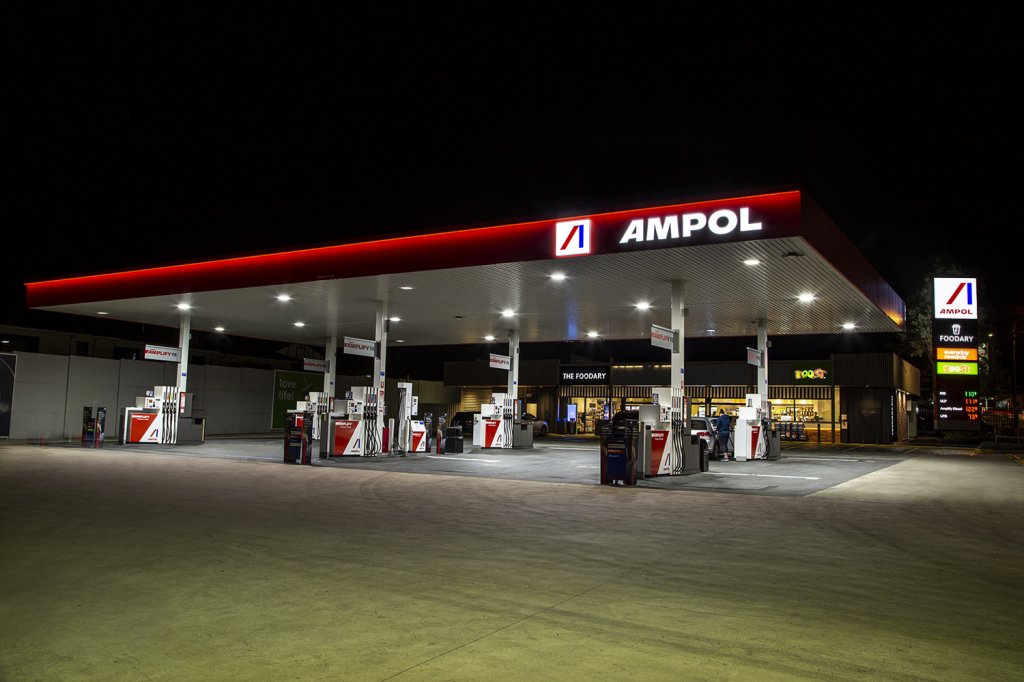
National rebranding programmes in the petro industry are significantly more complex than conventional corporate rebrands. For many businesses, a rebrand is largely centred on changing a visual identity across websites, marketing materials, offices and communications. For a petro company, the brand is embedded in a large physical network of operating sites. Changing that brand means coordinating physical infrastructure, customer-facing environments, regulatory requirements, suppliers and commercial relationships across hundreds or even thousands of locations.
At an individual petrol station, the change can touch almost every part of the site. Roadside pylons and price boards may need to be replaced, canopies and buildings repainted or reskinned, fuel dispensers updated, convenience stores redesigned, and uniforms and other customer touchpoints changed. Behind those visible elements sits another layer of complexity involving structural and electrical requirements, approvals, site access, manufacturing, logistics, contractor coordination and safety. Multiply those requirements across a national network, where every site has its own infrastructure and operating conditions, and the complexity increases quickly.
This is why a national petro rebrand should not be viewed simply as a brand identity project. It is a multi-site infrastructure, operational and organisational transformation that must be delivered while the underlying business continues to operate. The challenge is not simply to change what the network looks like, but to coordinate thousands of moving parts while protecting the operation underneath it.
What it takes to make a national rebrand work
The complexity of a national petro rebrand cannot be removed simply by creating a detailed rollout plan. What matters is having the capability, coordination and oversight to deliver that plan consistently across the network. Success depends on establishing consistency without ignoring local conditions, connecting every stage of delivery rather than managing them in isolation, and having the national capability to operate at scale while maintaining quality, safety and operational continuity.
Standardise the system, not every site
One of the central challenges of a national rebrand is balancing consistency with the realities of a diverse physical network. Brand standards may be national, but sites are not. Different structures, legacy assets, layouts, visibility requirements and operating conditions mean that applying exactly the same solution everywhere is rarely practical. The answer is standardisation rather than uniformity: creating a signage system that protects brand consistency and manufacturing efficiency while retaining enough flexibility to accommodate individual sites.
This was fundamental to the Ampol rollout, where more than 30 signage variations were required across a network of more than 1,700 locations. Coates’ early design and prototyping work helped establish a scalable system before national deployment began, reducing the need to solve the same problems repeatedly in the field. As Charles Hoare, Senior Director, Signage at Coates, puts it, “At national scale, standardisation does not mean assuming every site is the same. It means creating a system that protects the brand while giving the delivery team the flexibility to respond to the realities of each location.”
Connect the entire signage lifecycle
National rebrand programs become harder to control when design, manufacturing, logistics and installation are managed as separate workstreams. Decisions made at one stage can have consequences further down the line, while multiple suppliers create additional handovers, interfaces and responsibilities for the client to coordinate. At national scale, those gaps can quickly translate into delays, rework and uncertainty over who is responsible for resolving an issue.
For the Ampol rebrand, Coates’ involvement extended from concept development and rapid prototyping through detailed design, manufacturing, national logistics and installation. Bringing those capabilities together under one partner meant the signage lifecycle could be managed as a connected program rather than a series of separate activities, with decisions made in the context of how they would ultimately affect delivery at site. Charles explains the benefit, “When one partner manages the signage program end to end, there are fewer handovers and clear accountability for the outcome. We can connect design, manufacturing, logistics and installation as one program, and take responsibility for seeing it through.”
For a network operating across hundreds or thousands of locations, that model also reduces the management burden placed on the client. For Charles, the value is in giving clients a simpler way to manage complexity: “Our clients shouldn’t have to manage the gaps between multiple suppliers. Having one partner accountable across the program gives them one relationship, greater visibility and confidence that issues will be managed through to resolution.”
Combine national scale with local delivery
The final challenge is execution. A national petro network requires the capacity to manufacture and distribute significant volumes of signage, but scale alone is not enough. Delivery ultimately happens one location at a time, in live environments with their own access requirements, infrastructure, operating constraints and stakeholders. A successful rollout therefore needs national coordination and capacity combined with the ability to respond effectively at site level.
The Ampol rebrand demonstrates that balance. More than 59,000 signage products were deployed across more than 1,700 service station locations during a period of significant COVID-19 supply chain disruption, with the program completed on time and within budget. For Hoare, that distinction between scale and execution is critical: “National capability gets you to scale, but delivery still happens one site at a time. You need both: the systems and capacity to manage the network nationally, and the local capability to execute safely and consistently at each location.”
One point of accountability
What connects these capabilities is accountability. Standardisation, end-to-end partnership, national delivery capability, quality, durability, maintenance and safety are most valuable when they operate as one connected signage program rather than as separate services. Coates acts as one trusted partner with ownership across the signage lifecycle and one clear point of accountability for the customer. Instead of the brand having to coordinate multiple suppliers and resolve the gaps between workstreams, Coates takes responsibility for bringing those moving parts together and driving issues through to resolution.
There is also a commercial advantage to bringing these capabilities together, particularly at national scale. “When you manage a national signage program through one partner, you can make better use of that scale. Standardising specifications, consolidating manufacturing volumes and coordinating delivery across the network can improve operational efficiency, create cost efficiencies and deliver greater value for the client.” says Charles.
The Ampol rebrand illustrates what this level of coordination looks like in practice. Delivering more than 59,000 signage products across more than 1,700 locations was not simply an exercise in volume. It required design, manufacturing, logistics and installation to work as one coordinated program, while maintaining quality, controlling cost and allowing a live network to continue operating. National rebrands will always carry complexity, but having one partner accountable for the entire signage program can make that complexity easier to manage, while creating opportunities for greater efficiency and long-term value.